
UMC Hospitals, a leading gastroenterology hospital in Navi Mumbai, offers comprehensive, multidisciplinary care for digestive and liver disorders, combining medical gastroenterology, advanced endoscopy, and GI surgery to deliver accurate diagnosis and effective, minimally invasive treatment. Care pathways are individualized, covering prevention, day-care procedures, complex interventions, and long-term follow-up.
Investigation at one of the best gastroenterology hospitals in Navi Mumbai, UMC Hospitals, is guided by patient experiences.
Therapeutic ERCP addresses bile duct and pancreatic duct stones, strictures, and stenting in obstructive jaundice, conditions that once required open surgery. Endoscopic ultrasound (EUS) adds a layer of detail not visible on conventional imaging, enabling targeted biopsies and drainage procedures in the same sitting. For motility disorders, third-space endoscopy, POEM for achalasia, G-POEM for gastroparesis offer a surgical outcome through an endoscopic route. Early GI cancers and large polyps are removed via EMR or ESD, where appropriate, avoiding open surgery in carefully selected cases. Emergency endoscopy covers active GI bleeding, variceal banding, clipping, thermal therapy, and PEG placement when urgent intervention is required.
Surgery is recommended when there is a clear reason for it - not as a default, and not delayed when it is genuinely needed. Laparoscopic cholecystectomy remains one of the most common procedures, with same-day or next-day discharge in suitable patients. Hernias, inguinal, umbilical, or ventral, are repaired using TEP, TAPP, or open mesh techniques based on anatomy and clinical factors. Colorectal surgery for cancer, diverticular disease, and IBD strictures follows oncologic principles with ERAS-based recovery. Anorectal procedures, including hemorrhoidectomy, fissure surgery, and fistula repair, are tailored to anatomy and continence goals, not standardized. Upper GI surgery addresses refractory reflux, paraesophageal hernia, and complex ulcers in selected cases. For HPB and pancreatic resections, including Whipple's candidates, care is planned in collaboration with specialized surgical partners.
Fatty liver, viral hepatitis, autoimmune liver disease, and cirrhosis are managed with structured protocols rather than a wait-and-watch approach. Portal hypertension pathways include variceal surveillance, band ligation, bleeding prevention, and nutrition optimization, each addressed as part of a connected plan, not in isolation. Pancreatitis, both acute and chronic, is managed with targeted nutrition support, pain control, and ERCP or EUS interventions where indicated. Surgery is required in rare cases.
GERD management starts with lifestyle and medication, and for many patients, that is enough. When symptoms persist despite adequate treatment, endoscopic or surgical options are considered in a stepwise manner. Achalasia and other motility disorders are evaluated with manometry before any treatment decision is made, then managed via POEM or surgical myotomy depending on candidacy. Swallowing difficulties and functional bowel disorders are approached through a combination of medical, dietary, and behavioral therapy, because no single intervention addresses all the contributing factors.
Crohn's disease and ulcerative colitis are managed through structured pathways, regular monitoring, medication optimization, and nutrition support built in from the start, not added when things go wrong. IBS clinics focus on identifying symptom triggers, low-FODMAP dietary guidance, and stress management, recognizing that gut symptoms rarely have a single cause. When medical management reaches its limits, escalation to advanced therapies or surgery follows clear, agreed criteria.
Children with reflux, constipation, abdominal pain, celiac disease, or liver conditions are evaluated in a setting designed for them, not a scaled-down adult clinic. Pediatric endoscopy is performed under age-appropriate anesthesia, with recovery plans and education aimed at parents as much as patients. Findings are communicated clearly, and follow-up is structured around the child's needs and growth.
A significant number of endoscopic and minor surgical procedures are performed as day care, with patients going home the same day. ERAS-based protocols guide pain control, hydration, and early mobilization from the moment the procedure ends. Before discharge, patients receive clear instructions on diet progression, wound care, and what to watch for, so recovery at home is as predictable as recovery in the hospital.
High-definition and image-enhanced endoscopy supports early lesion detection. Protocol-driven infection control, anticoagulation management, and surgical safety checklists are part of every procedure. Multidisciplinary case reviews and ongoing quality audits ensure standards are held across routine and complex cases alike.
The first visit usually uncovers more than the patient expected to discuss. Digestive symptoms need context: how long, how often, what makes them worse, and what has already been tried. Treatment options are explained in detail. Follow-ups track symptom control, healing, and nutrition, not just whether the procedure went well.
For a gastroenterology consultation, endoscopy, colonoscopy, or GI surgery evaluation, visit the best gastroenterologist in Navi Mumbai at UMC Hospitals. Request a call-back or schedule a visit. The team will guide preparation, investigations, and next steps.
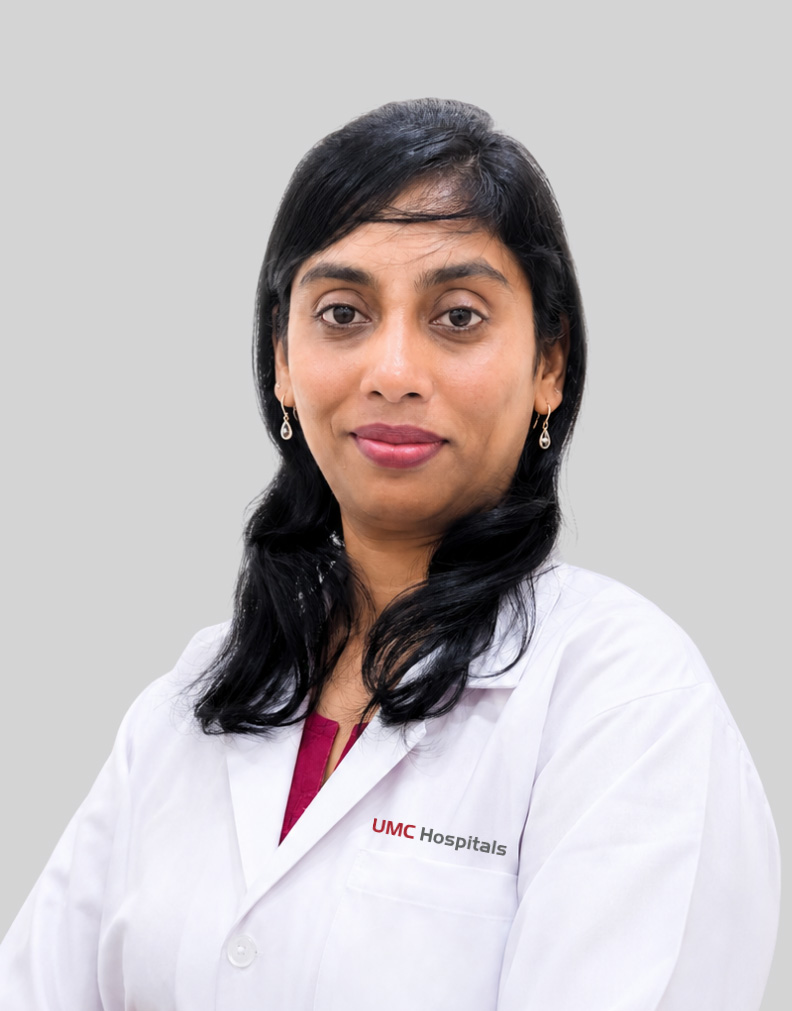
Dr. Deepti Vishwanathan
Gastroenterology & GI Surgery
Group Member of 

